

Dips and Spreads Market Analysis 2026–2036: Global Market to Reach USD 188.33 Billion by 2036 at 5.4% CAGR
Dips and Spreads Industry Size
Dips and spreads market grows steadily, driven by premium hummus, single-serve formats, and rising demand for convenient, plant-based snacking options.
NEWARK, DE, UNITED STATES, March 24, 2026 /EINPresswire.com/ -- According to analysis by Future Market Insights (FMI), the global dips and spreads market is undergoing structural transformation as packaging format innovation, premiumization of core products, and evolving retail merchandising strategies redefine value creation and competitive positioning across the category.
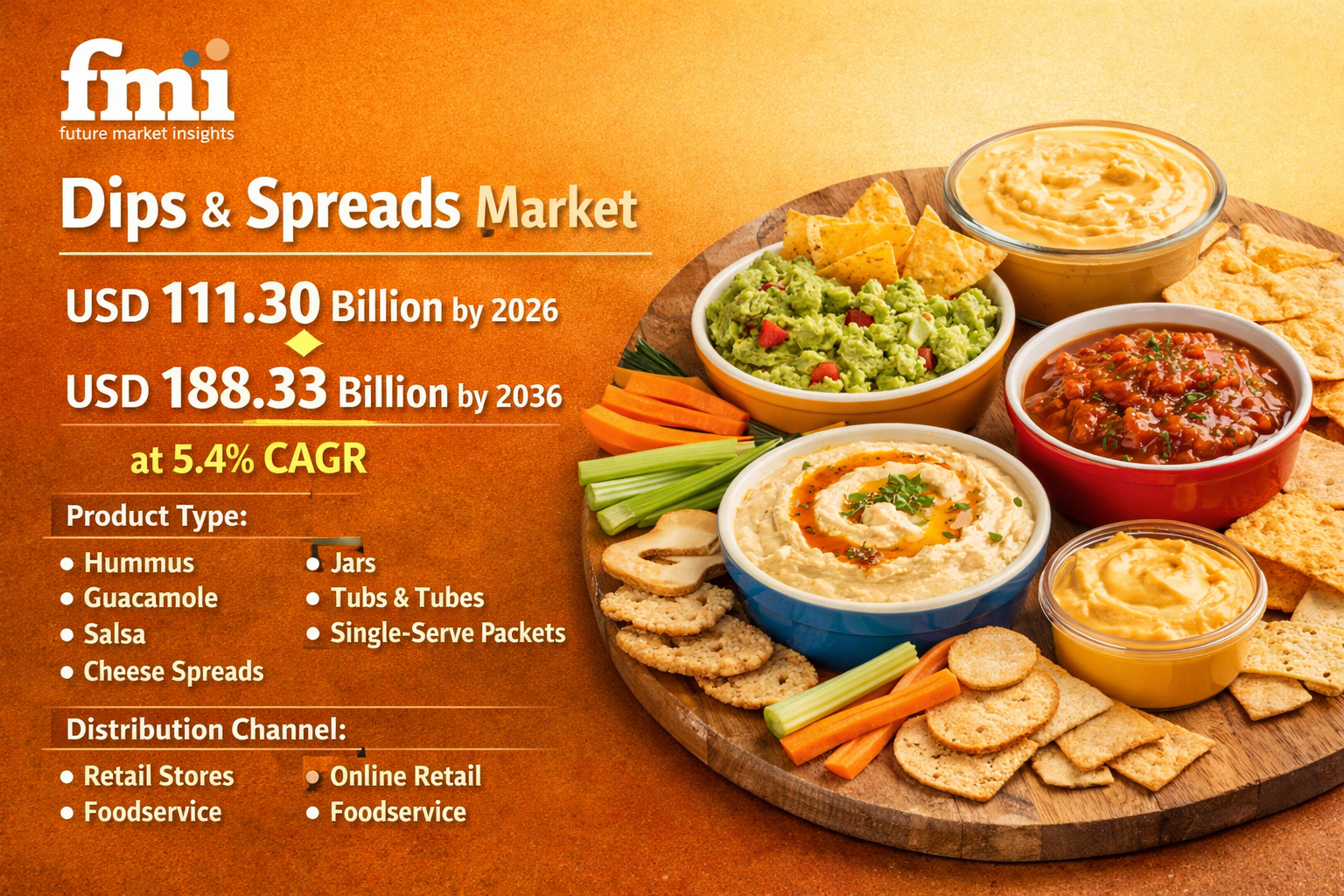
The dips and spreads market was valued at USD 40.65 billion in 2025 and is projected to reach USD 111.30 billion in 2026. Over the forecast period, demand is expected to expand at a CAGR of 5.4%, ultimately reaching USD 188.33 billion by 2036.
This growth trajectory is primarily supported by value expansion rather than volume acceleration, with premium hummus, guacamole, and plant-based cheese spreads driving incremental revenue gains. Mature markets are witnessing moderate volume growth, while pricing strategies, pack-size optimization, and clean-label reformulation continue to enhance profitability.
Get Access of Report Sample: https://www.futuremarketinsights.com/reports/sample/rep-gb-22852
Dips and Spreads Market Snapshot
• Market Value (2025): USD 40.65 Billion
• Forecast Value (2036): USD 188.33 Billion
• Forecast CAGR (2026–2036): 5.4%
• Leading Product Type: Hummus (27.6% share)
• Top Distribution Channel: Retail Stores (48.7% share)
• Fastest Growing Market: China
Packaging Format Economics and Premiumization Drive Market Expansion
A key force shaping the dips and spreads market is the shift from traditional jar formats to high-margin, single-serve packaging. Consumers are increasingly trading up from commodity jars to convenient snack packs, enabling manufacturers to generate significantly higher revenue per kilogram.
Premiumization across hummus, guacamole, and plant-based spreads is reinforcing category value, as brands leverage clean-label ingredients, protein-forward positioning, and global flavor innovation to attract health-conscious consumers. The convergence of convenience and nutrition is accelerating adoption across both retail and foodservice channels.
Retail Shelf Reallocation Reshapes Competitive Dynamics
The competitive landscape is shifting from brand-driven loyalty to shelf-space optimization and merchandising strategies. Retailers are expanding refrigerated sections and allocating greater space to fresh, single-serve, and multi-pack dips, reducing visibility for ambient jar-based products.
This structural transition is driving value migration within the category, favoring brands that invest in cold-chain logistics and high-speed single-serve production capabilities. Companies that fail to adapt risk losing shelf facings to agile competitors and private-label players.
Supply Chain and Cold-Chain Capabilities Influence Growth
Cold-chain infrastructure has emerged as a critical enabler of growth, particularly as retailers prioritize fresh and minimally processed dips over shelf-stable alternatives. Manufacturers with advanced refrigerated distribution networks are better positioned to secure retail partnerships and maintain product quality.
Simultaneously, procurement strategies are evolving, with companies entering long-term supply agreements to ensure consistent access to high-quality raw materials such as chickpeas, avocados, and dairy inputs.
Retail Stores Lead Distribution Channel Growth
By distribution channel, retail stores are expected to account for 48.7% of the market in 2026.
Growth in this segment is supported by:
• Expansion of refrigerated shelf space in supermarkets and hypermarkets
• Strong in-store visibility and impulse purchasing behavior
• Increasing availability of premium and private-label offerings
Meanwhile, online retail and foodservice channels are expanding steadily, supported by convenience, wider product assortment, and growing demand for ready-to-eat snacking solutions.
Hummus Dominates Product Demand
By product type, hummus is projected to lead with a 27.6% market share.
Its dominance is driven by:
• Strong alignment with plant-based and protein-rich diets
• Growing popularity of Mediterranean cuisine
• Versatility across meal occasions and snacking formats
Continuous innovation in flavors and formulations is expected to sustain its leadership position across global markets.
Regional Growth Trends Highlight Emerging Opportunities
The dips and spreads market reflects varied growth trajectories across key countries:
• China: 7.3%
• India: 6.8%
• Germany: 6.2%
• France: 5.7%
• United Kingdom: 5.1%
• United States: 4.6%
• Brazil: 4.1%
China leads global growth, driven by rising urbanization, increasing consumption of western-style foods, and expanding retail infrastructure. India follows closely, supported by a growing middle class and increasing demand for convenient, ready-to-eat snacks.
Mature markets such as the United States and Brazil are expected to grow steadily, driven by product innovation, reformulation, and replacement demand.
Flavor Innovation, Health Trends, and Packaging Drive Demand
The market is benefiting from several key trends:
• Rising demand for bold, globally inspired flavors
• Growth in plant-based, low-fat, and clean-label formulations
• Increasing adoption of single-serve and convenience packaging
• Strategic collaborations and co-branding initiatives
These trends are reinforcing dips and spreads as a core component of modern snacking and meal enhancement.
Competitive Landscape
Leading companies in the dips and spreads market include:
• The Kraft Heinz Company
• Nestlé S.A.
• Conagra Brands, Inc.
• Hormel Foods Corporation
• General Mills, Inc.
• PepsiCo, Inc.
• Sabra Dipping Company
• Cedar’s Mediterranean Foods
• Stonewall Kitchen
• Lancaster Colony Corporation
These players are focusing on packaging innovation, flavor diversification, strategic partnerships, and expansion of refrigerated product lines to strengthen their market position.
Market Outlook: Value Migration Toward Premium and Convenient Formats
The long-term outlook for the dips and spreads market remains positive, with growth increasingly driven by value optimization rather than volume expansion. Packaging format innovation, particularly single-serve solutions, will continue to reshape margin structures and competitive dynamics.
As consumers prioritize convenience, health, and flavor diversity, brands that invest in cold-chain capabilities, premium formulations, and differentiated packaging formats will emerge as market leaders. The transition toward fresh, refrigerated, and high-value products is expected to define the next phase of category evolution.
Browse More Reports:
Phytosterol Market: https://www.futuremarketinsights.com/reports/phytosterols-market
Flavor and Flavor Enhancers Market: https://www.futuremarketinsights.com/reports/flavour-and-flavour-enhancers-market
Acai Berry Market: https://www.futuremarketinsights.com/reports/acai-berry-market
Ursolic Acid Market: https://www.futuremarketinsights.com/reports/ursolic-acid-market
Sudip Saha
Future Market Insights Inc.
+ +1 347-918-3531
email us here
Legal Disclaimer:
EIN Presswire provides this news content "as is" without warranty of any kind. We do not accept any responsibility or liability for the accuracy, content, images, videos, licenses, completeness, legality, or reliability of the information contained in this article. If you have any complaints or copyright issues related to this article, kindly contact the author above.
