

Get your daily news on global issues
Provided by AGP
Vitreous Detachment Treatment Market to Reach US$ 5.3 Bn by 2033, Growing at 4.5% CAGR: Persistence Market Research
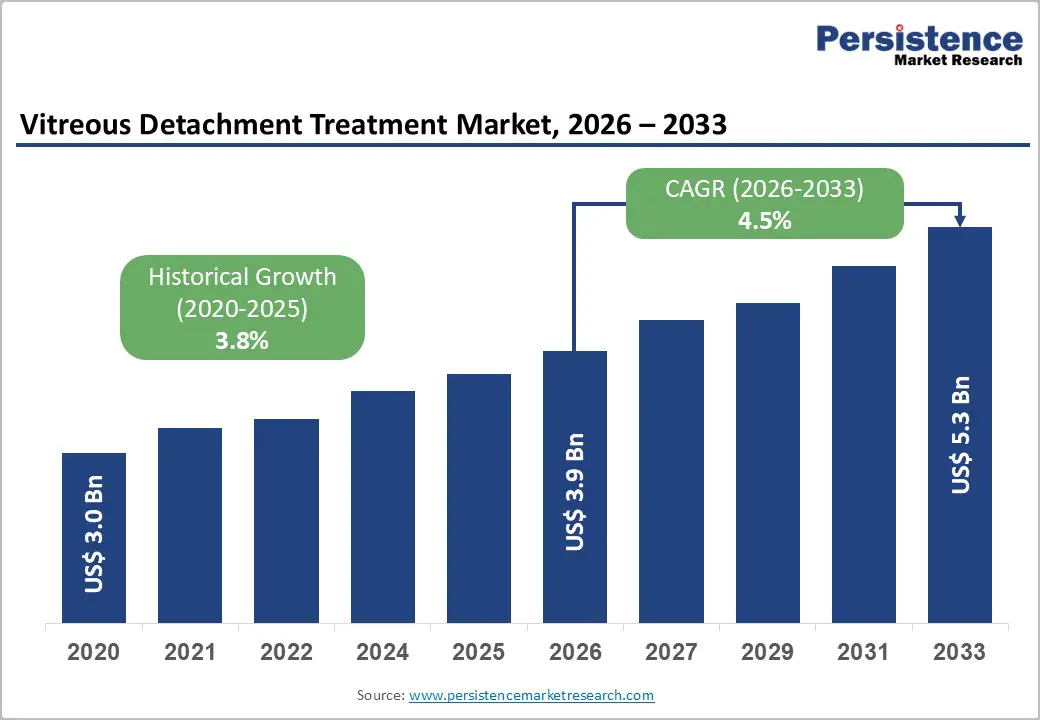
vitreous detachment treatment market
The vitreous detachment treatment market is growing due to aging populations, advanced therapies, minimally invasive procedure, and expanding healthcare access.
LONDON, UNITED KINGDOM, May 6, 2026 /EINPresswire.com/ -- The global vitreous detachment treatment market is projected to be valued at approximately US$ 3.9 billion in 2026 and is expected to reach US$ 5.3 billion by 2033, registering a compound annual growth rate (CAGR) of 4.5% during the forecast period from 2026 to 2033. The market growth is primarily driven by an aging population, which has led to an increased prevalence of vitreous detachment and associated ocular disorders.
Rising clinical awareness among ophthalmologists and optometrists is supporting early diagnosis and intervention, boosting the adoption of advanced treatment modalities. Integration of laser technologies, minimally invasive vitrectomy procedures, and pharmacologic agents has enhanced treatment precision and patient outcomes. Expansion of healthcare infrastructure, particularly in urban and semi-urban regions, has increased the accessibility of ophthalmic services and specialized centers. Additionally, improved reimbursement policies and patient education campaigns have reduced barriers to treatment uptake, contributing to market demand.
Download Your Free Sample & Explore Key Insights: https://www.persistencemarketresearch.com/samples/30391
Key Industry Highlights
North America is expected to dominate the market with roughly 40% share in 2026, driven by its advanced healthcare and medical infrastructure. The Asia Pacific region is forecasted to be the fastest-growing market between 2026 and 2033 due to increasing adoption of treatment procedures. Vitrectomy is expected to lead as a treatment method with around 55% revenue share in 2026, owing to its clinical efficacy and broad acceptance, while laser therapy is projected to grow the fastest during the same period due to its minimally invasive nature and higher patient adherence.
Aging Population and Increasing Prevalence of Vitreous Disorders
The rising elderly population significantly influences demand for clinical management of age-related vitreous changes. As individuals age, the vitreous humor transitions from a gel-like to a more liquid state, weakening its adhesion to the retina. This degeneration increases the likelihood of posterior vitreous detachment, particularly in individuals over 50 years, and is extremely common in those above 80. Age-related structural changes result in higher intervention rates to address symptomatic detachment and complications such as retinal tears or vision-disrupting floaters.
Global demographic trends indicate an increasing elderly population, which raises the prevalence of vitreous disorders requiring medical attention. Older adults are more susceptible to vitreous degeneration and related complications, driving the demand for advanced diagnostics and surgical interventions. Healthcare systems must allocate resources to manage rising caseloads of age-linked ocular disorders and associated visual consequences.
Regulatory and Procedural Complexity
Stringent regulatory frameworks affect market entry, product approvals, and clinical evaluations. Medical devices and pharmaceuticals undergo comprehensive assessments to ensure safety and compliance, prolonging approval timelines and increasing operational costs. Hospitals and ophthalmology centers adhere to detailed procedural protocols and training requirements, influencing operational complexity and adoption rates.
Emerging Markets with Expanding Healthcare Infrastructure
Emerging economies such as India and China are witnessing rapid healthcare infrastructure expansion, increasing accessibility to ophthalmic services. Government initiatives, improved insurance coverage, and development of trained specialists are driving procedural volumes and market growth. Outpatient clinics and ambulatory surgical centers (ASCs) are becoming increasingly important in expanding access to vitrectomy and laser therapy.
Get Custom Insights Designed for Your Businecss: https://www.persistencemarketresearch.com/request-customization/30391
Integration of Digital Health and Teleophthalmology
Teleophthalmology and digital health technologies enable remote consultations, diagnostic review, and patient monitoring. Fundus imaging, OCT scans, and symptom tracking facilitate early detection and management, reducing reliance on in-person appointments. Digital integration improves operational efficiency, expands specialist reach, and generates real-world evidence for informed clinical decisions.
Category-wise Analysis
Vitrectomy is expected to capture around 55% of the market revenue in 2026 due to its efficacy in managing advanced vitreous detachment and complications such as retinal tears. Laser therapy is projected to grow fastest due to minimally invasive procedures, precision targeting with OCT imaging, and shorter recovery periods. Hospitals dominate end-user share with nearly 50% of revenue, supported by advanced surgical facilities, while ASCs are the fastest-growing segment due to cost efficiency and procedural convenience.
Regional Insights
North America leads the market due to advanced infrastructure, specialist availability, and robust reimbursement frameworks. Europe maintains a significant share with sophisticated ophthalmic networks and early detection programs. Asia Pacific is the fastest-growing region, driven by expanding infrastructure, patient awareness, government initiatives, and private sector investment in ophthalmology services.
Competitive Landscape
The market is moderately fragmented, with major players including Johnson & Johnson Vision, Bausch + Lomb, Alcon, Carl Zeiss Meditec, Nidek, and Topcon. Key strategies involve innovation, minimally invasive technologies, and partnerships with healthcare providers. New entrants focus on high-precision vitrectomy systems and laser platforms to differentiate in a competitive environment.
Key Industry Developments
Recent innovations include biohybrid hydrogel vitreous body replacements, dual-function surgical platforms combining phacoemulsification and vitrectomy, and biodegradable retinal hydrogel sealants. These developments aim to enhance surgical outcomes, reduce complications, and expand patient access to advanced vitreous detachment treatments.
Companies Covered
Johnson & Johnson Vision, Bausch + Lomb, Alcon, Carl Zeiss Meditec, Nidek, Topcon, Hoya Surgical Optics, Ellex Medical Lasers, Optos, STAAR Surgical, Heidelberg Engineering, Rayner, Haag-Streit, MediWorks.
Checkout Now & Download Complete Market Report: https://www.persistencemarketresearch.com/checkout/30391
Market Segmentation
By Treatment Type
Laser Therapy
Vitrectomy
Medication Treatments
Others
By Patient Demographics
Age Group
Gender
Health Status
Lifestyle Factors
By End-User
Hospitals
Ophthalmic Clinics
Ambulatory Surgical Centers (ASCs)
Others
By Region
North America
Europe
East Asia
South Asia & Oceania
Latin America
Middle East & Africa
Read Related Reports:
SDS Poly Acrylamide Gel Electrophoresis Market: The SDS polyacrylamide gel electrophoresis market is expected to grow from $574.6M in 2026 to $824.8M by 2033, at a CAGR of 5.3% during the forecast period.
Pet Snacks and Treat Market: The pet snacks market is projected to grow from US$50.6 Bn in 2026 to US$89.6 Bn by 2033 at 8.5% CAGR, driven by pet humanization and demand for healthy treats.
Persistence Market Research
Persistence Market Research Pvt Ltd
+1 646-878-6329
email us here
Visit us on social media:
LinkedIn
Instagram
Facebook
YouTube
X
Legal Disclaimer:
EIN Presswire provides this news content "as is" without warranty of any kind. We do not accept any responsibility or liability for the accuracy, content, images, videos, licenses, completeness, legality, or reliability of the information contained in this article. If you have any complaints or copyright issues related to this article, kindly contact the author above.
