

Get your daily news on global issues
Provided by AGP
Space Economic Forum and Korea Institute for Astronauts Form Strategic Alliance For Multi-Trillion-Dollar Space Economy
Korea Institute for Astronauts - Space Economic Forum - Cover
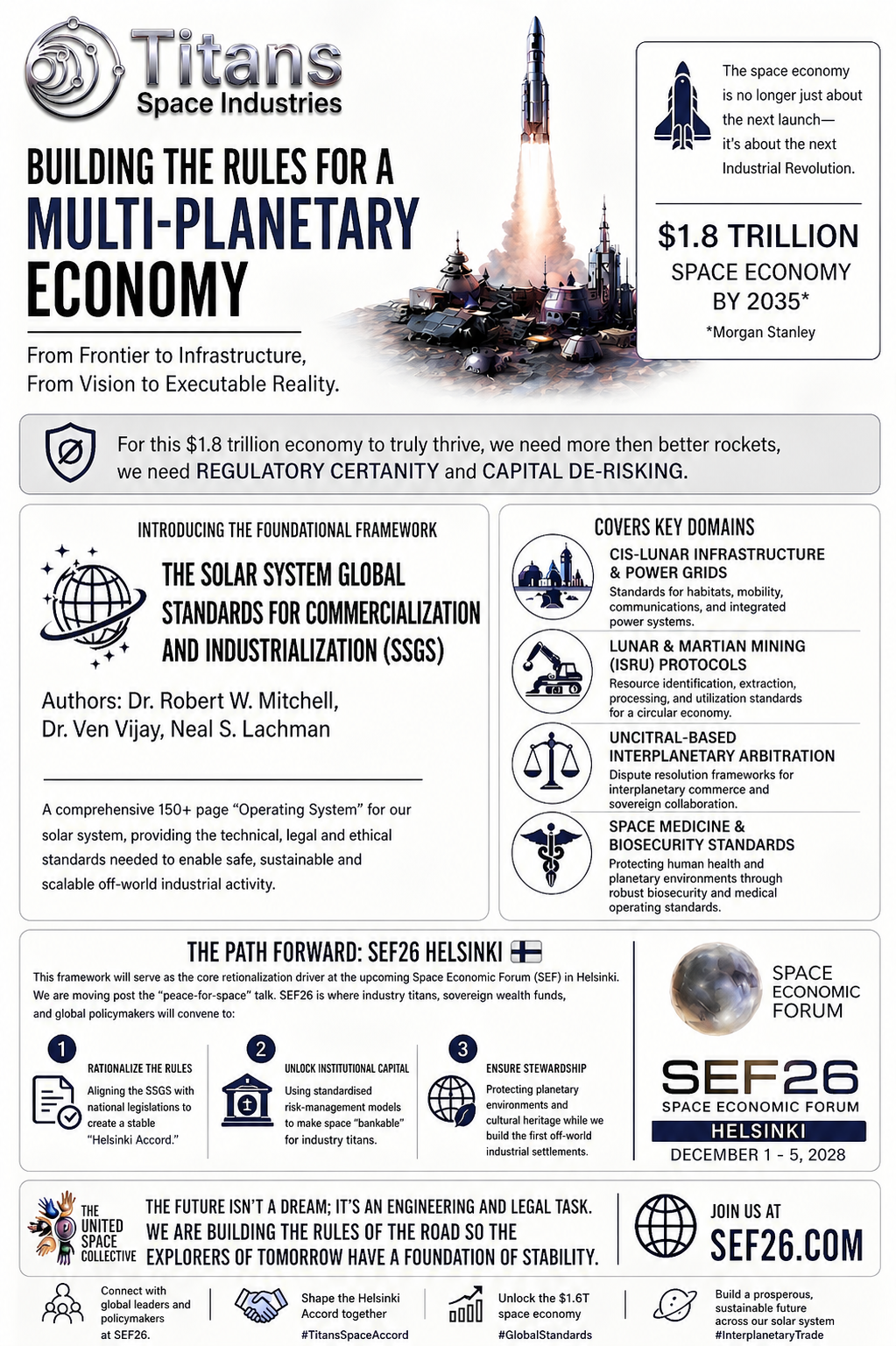
Solar System Global Standards - SSGS - Helsinki Space Accords
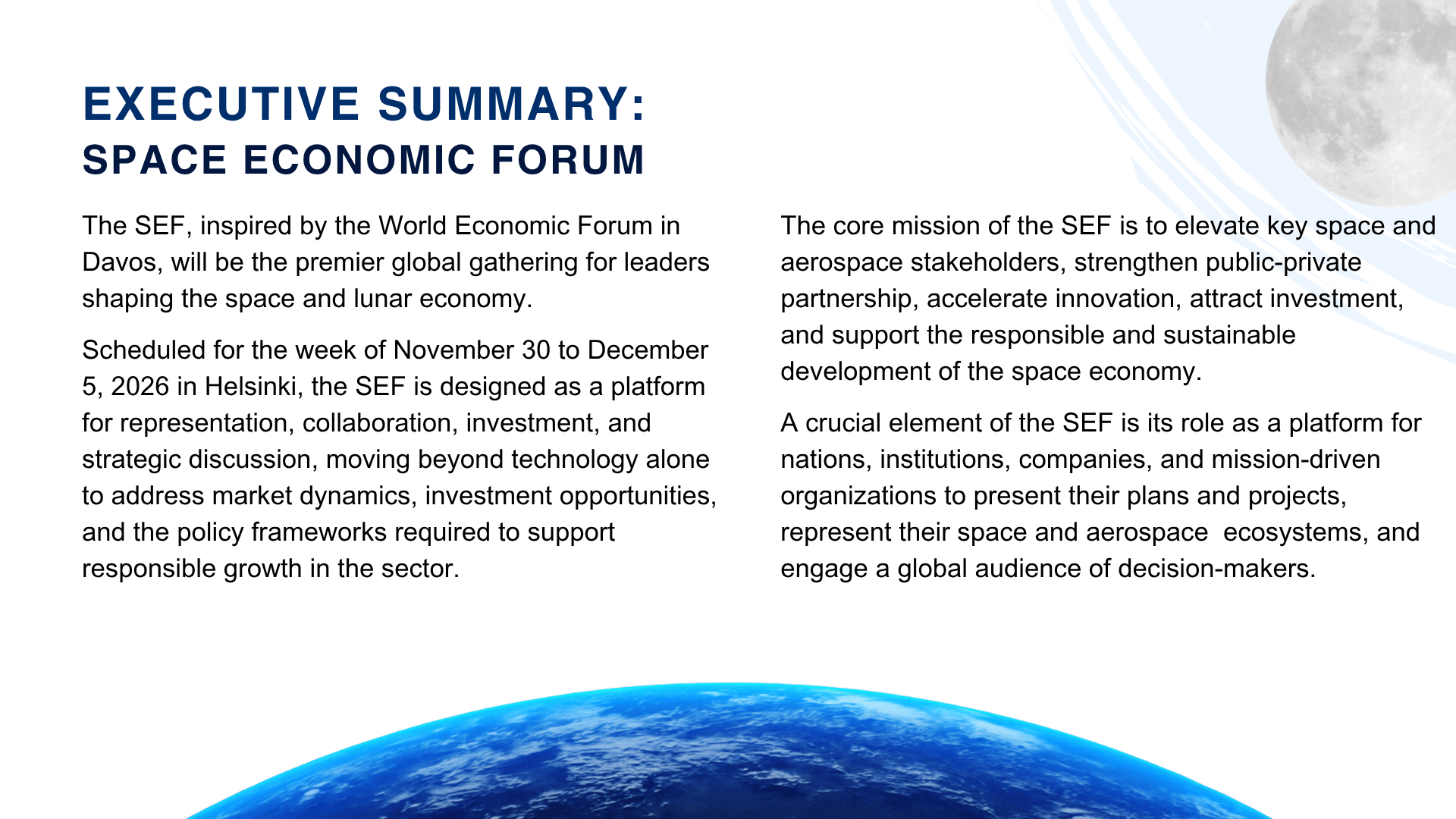
Space Economic Forum - Exec Summary 1
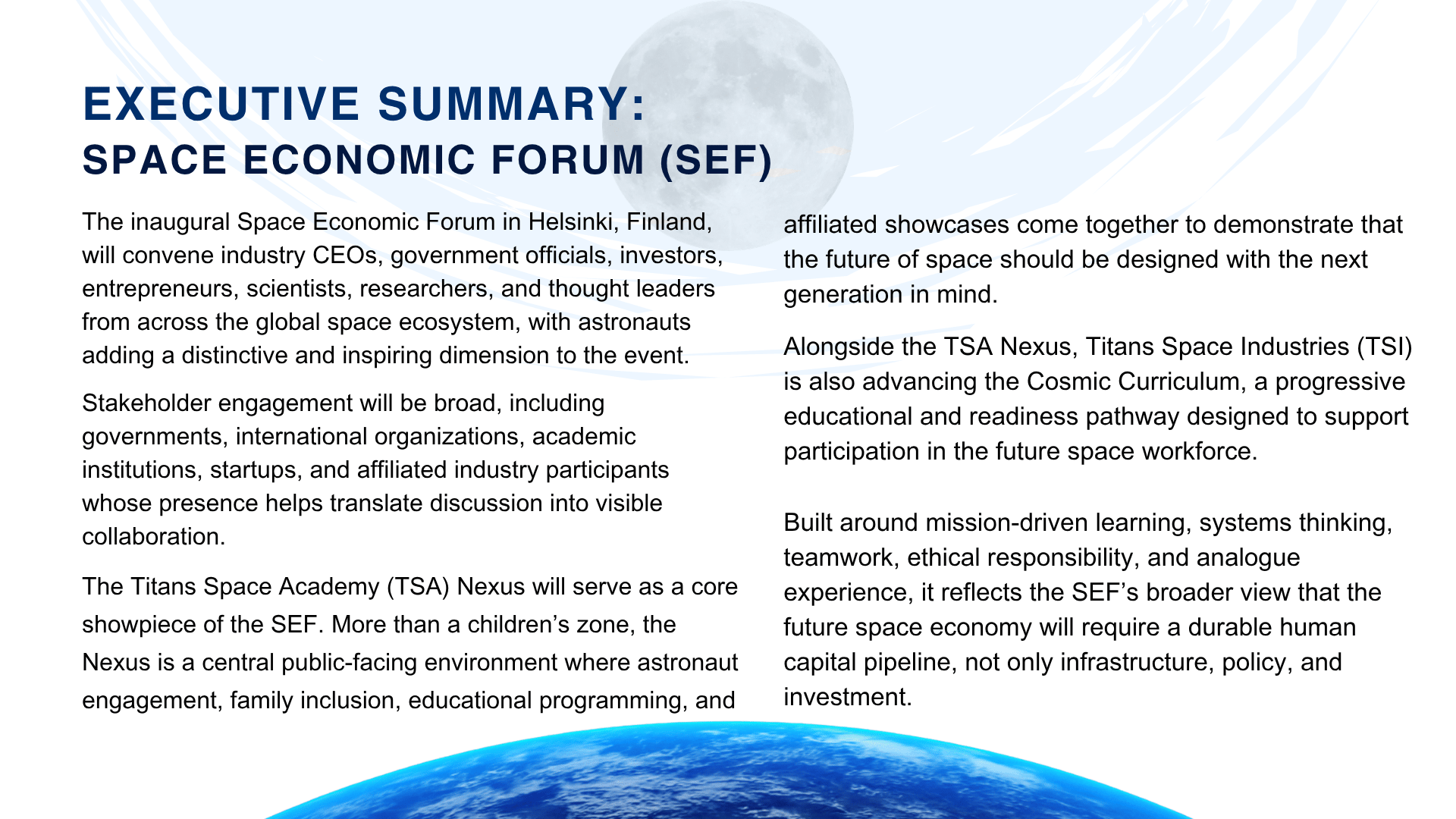
Space Economic Forum - Exec Summary 2
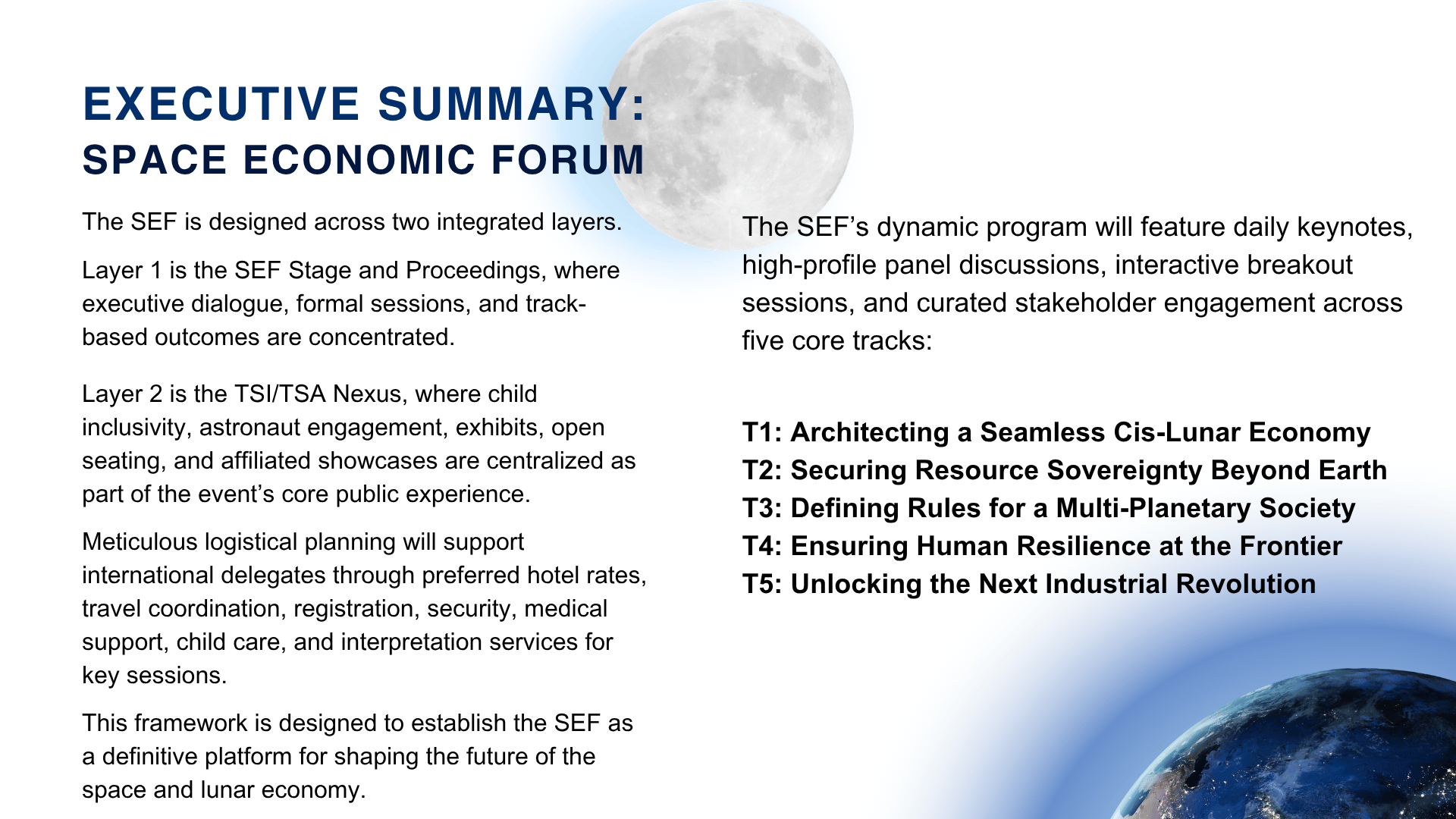
Space Economic Forum - Exec Summary 3
The partnership between SEF and KIFA recognizes that the multi-trillion-dollar space economy requires immediate regulatory certainty and capital de-risking.
The transition to a large-scale commercial cis-lunar economy requires more than just technology; it requires a unified set of rules that all nations and corporations can follow. ”
ORLANDO, FL, UNITED STATES, May 18, 2026 /EINPresswire.com/ -- Space Economic Forum LLC (SEF) and the Korea Institute for Astronauts (KIFA) at Kookmin University (Seoul), have officially entered into a landmark Memorandum of Understanding (MOU) and Strategic Partnership Agreement. This collaboration marks a major step in transitioning the space economy from a frontier to a multi-planetary infrastructure by the year 2035.— Prof. David William Kim, Korea Institute for Astronauts
Redefining the Space Industrial Complex: SEF 2026
The Space Economic Forum (SEF), organized by N.S.Lachman & Co. LLC, on behalf of Titans Space Industries Inc., serves as the primary global theater for the standardization and commercialization of the solar system.
Scheduled for December 1–5, 2026, at Messukeskus, Helsinki Expo and Convention Centre (Helsinki, Finland), the forum will convene sovereign leaders, institutional investors, and aerospace pioneers to move beyond theoretical exploration toward a unified industrial roadmap.
The core driver of the 2026 summit is the ratification of the Solar System Global Standard for Commercialization and Industrialization (SSGS).
This foundational framework is designed to eliminate the technical and administrative "friction" currently hindering off-world expansion. By establishing universal benchmarks for interoperability, safety, and legal recourse, the SSGS provides the "rules of the road" necessary to de-risk capital investments and scale infrastructure—such as the Titania Lunar settlement—into a sustainable and thriving (multi-trillion-dollar) cis-lunar economy.
At the heart of the Helsinki proceedings will be the drafting of the Helsinki Space Accords, a seminal multilateral agreement intended to align the SSGS with national legislations. This initiative ensures that the transition to a multi-planetary society is governed by a modular, transparent, and ethically robust system, protecting both the environment of space and the commercial interests of those building within it.
A Vision for Regulatory Certainty
The partnership between SEF and KIFA is built on the shared recognition that the burgeoning multi-trillion-dollar space economy requires immediate regulatory certainty and capital de-risking. To address this, SEF and global institutions like KIFA will focus on refining and ratifying the Solar System Global Standards (SSGS), a comprehensive framework designed to bridge the gap between academic research and off-world industrialization.
Under this mandate, KIFA will serve as a key institutional collaborator across several critical domains:
Cis-Lunar Infrastructure: Establishing standards for habitats, mobility, and integrated power systems.
Lunar & Martian Mining (ISRU): Developing protocols for resource extraction and a circular space economy.
Space Medicine & Biosecurity: Leveraging KIFA’s expertise to create robust medical operating standards for off-world settlements.
Interplanetary Arbitration: Supporting dispute resolution frameworks for sovereign and corporate collaboration.
The Helsinki Space Accords and Global Leadership
A cornerstone of this agreement is the integration of KIFA leadership into the global stage. Prof. David W. Kim, FRAS, FRHistS will serve as a Contributing Architect for the "Helsinki Space Accords." This initiative aims to align SSGS with national legislations, particularly within South Korean and broader Asian frameworks. Furthermore, KIFA will be recognized as a Founding Institutional Partner of the "United Space Collective," joining a global coalition dedicated to ensure cis-lunar sustainability and protecting planetary environments and cultural heritage.
Leadership Perspectives
"This partnership represents a bridge between scientific excellence and the economic frameworks required for the next industrial revolution," said Neal NSL Lachman - CEO - Titans Space Industries Inc. (owner of the SEF event) and CEO of N.S.Lachman & Co. LLC (organizer of SEF 2026 in Helsinki). "As we move forward with our commercial plans for the industrialization of the Moon, specifically through our large-scale Titania Lunar settlement, the need for standardization via the SSGS becomes paramount. By integrating input and expertise of institutions like KIFA under Prof. Kim’s pioneering leadership, we ensure that these lunar industrial hubs operate under a unified, global set of standards that promote safety and scalability."
"The inclusion of the Korea Institute for Astronauts into the SSGS framework brings an unparalleled level of academic and scientific rigor to our mission,” stated Dr. V Vijay, MD, FRCSC, COO and Deputy Chief of Astronautics, Titans Space Industries Inc. "We anticipate that Prof. Kim and his team, including Prof. Ravi Gupta, Prof. Emmanuel Wolfs, and Prof. Do Youn Lee, will provide elements of the critical leadership necessary to bridge the gap between astronautic research and the industrial-scale standards required for the upcoming multi-trillion-dollar cis-lunar economy. Their role as academic auditors ensures that the global standards for biosecurity and lunar logistics are not only visionary but technically executable."
"The ratification of the Solar System Global Standards (SSGS) is the cornerstone of our mission to ensure a seamless transition into a multi-planetary economy,” said Dr. Robert W. Mitchell, Ph.D, Titans Space Astronaut Candidate, Chief R&D Officer and Chief of Global Standards, Titans Space Industries Inc. “With the Korea Institute for Astronauts joining as a Lead Academic Auditor, we are integrating world-class scientific rigor into our technical protocols. Prof. Kim and his team will be instrumental in finalizing the standards for Lunar and Martian ISRU, space business, spacewalk system, spacesuit, biosecurity, space medicine, astronaut training, management, and wellbeing, zero-gravity research, habitat mobility, safety and risk management, and space policy, providing the essential 'Helsinki Space Accords' alignment that the global space industry requires for the sustainable development of projects like Titania Lunar."
Prof. David William Kim of the Korea Institute for Astronauts added: "The transition to a large-scale commercial cis-lunar economy requires more than just technology; it requires a unified set of rules that all nations and corporations can follow. We are honored to contribute our innovative research and expertise to the Helsinki Space Accords and to lead the effort in rationalizing these standards for the global community."
Operational and Academic Synergy
The alliance between SEF and KIFA extends into operational and research excellence through several high-impact initiatives:
- SSGS Advisory Board: KIFA will hold a permanent seat on the Global Ethics & Biosecurity Committee to oversee medical, environmental, and teamwork standards.
- Global Publication: SEF will provide KIFA with a dedicated section in official proceedings and white papers, reaching sovereign wealth funds and institutional investors.
- Technical Workshops: SEF will co-host "SSGS Deep-Dives" where KIFA experts will lead workshops on ISRU protocols for commercial partners.
KIFA and Titans Space Industries Partnership
In November last year, KIFA and TSI announced an agreement where both organizations will collaborate on:
- Joint Space Activities: Conducting cooperative projects in astronaut training and commercial space operations
- Knowledge Exchange: Sharing scientific and technological information to advance space exploration capabilities
- Professional Development: Facilitating exchange programs for space professionals and researchers
- Academic Collaboration: Exchanging academic materials and publications to foster innovation in space science
This international alliance also established a collaborative global talent pipeline in South Korea to source elite researchers, engineers, and scientists for the Titans Space ASCAN (Astronaut Candidate) Programme. These South Korean specialists will be integrated directly as Career Astronauts within TSI’s active Research & Development (R&D) and Expedition & Development (E&D) tracks, directly contributing to the precision engineering of the company’s advanced spacecraft and upcoming lunar habitat systems.
(Read the announcement: https://www.linkedin.com/pulse/titans-space-industries-korea-institute-astronauts-neal-nsl--loa0e/)
Invitation to Global Leadership: The United Space Collective
The Space Economic Forum formally invites government officials and decision-makers, leading space executives, distinguished academic institutions, and visionary scholars to join the United Space Collective. This is a call to become founding architects and strategic partners in the development of the Solar System Global Standards (SSGS), the definitive regulatory and technical framework for the industrialization of the lunar and orbital frontiers.
Join us in Helsinki this December to define the standards of a multi-planetary future.
As the space economy transitions from theoretical research to large-scale infrastructure, the Collective serves as the intellectual backbone for this new era. Members will play a decisive role in drafting the Helsinki Space Accords, ensuring that the standards for off-world habitation, resource extraction, and interplanetary governance are technically rigorous, ethically sound, and commercially scalable.
How to Apply
We are seeking partners who possess deep expertise in aerospace engineering, space law, planetary science, and off-world medicine.
To initiate the partnership process:
Email: Please send an email to partnerships[at] sef26.com, to express your personal and/or institution's interest.
Introduction: Provide a brief overview of relevant information (e.g. your department’s research focus and relevant contributions to the aerospace sector).
Review: Following an initial alignment check, you will receive a formal Invitation to apply for founding membership in the United Space Collective.
About Korea Institute for Astronauts (KIFA)
Based at Kookmin University in Seoul, KIFA is a leading academic institution committed to preparing humanity for space exploration through comprehensive, multidisciplinary research. As they focus on human factors in space, KIFA brings experts from diverse STEM and non-STEM fields of space science and human science dedicated to astronautic research, training, and the advancement of space medicine, as well as security and space occupational professionalism.
This collaborative approach enables to address the complex challenges of long-duration human spaceflight, especially in preparation for Moon and Mars missions projected for the 2030s. Thus, KIFA’s core mission is to develop practical, evidence-based solutions that enhance astronaut safety, health, and performance in extreme environments.
- Website: https://kifaspace.org/
- KIFA Research Team: https://kifaspace.org/korea-institute-for-astronauts-research-team
-
About the Space Economic Forum 2026
The Space Economic Forum is the premier global platform for the standardization, commercialization, and industrialization of the solar system.
The Forum is organized by N.S. Lachman & Co. LLC and owned by Titans Space Industries Inc.
The Forum is driven by the establishment of the Solar System Global Standards (SSGS), a foundational framework designed to standardize the commercialization and industrialization of space.
Central to this initiative is the development of the "Helsinki Accord," a seminal document that will define the regulatory, technical, and economic benchmarks necessary for a sustainable cis-lunar civilization. By implementing these standards, the SEF aims to reduce administrative "friction" and create a modular, interoperable environment where diverse global stakeholders—from sovereign nations to private enterprises—can safely and efficiently scale operations across the lunar and orbital frontiers.
- Website: www.SEF26.com
- Venue: https:/SEF26.com/Venue-Messukeskus/
- Host City: https://SEF26.com/Host-City/
Sue Guvener
Lachman Capital Partners LLC
+1 3214018425
email us here
Visit us on social media:
LinkedIn
Legal Disclaimer:
EIN Presswire provides this news content "as is" without warranty of any kind. We do not accept any responsibility or liability for the accuracy, content, images, videos, licenses, completeness, legality, or reliability of the information contained in this article. If you have any complaints or copyright issues related to this article, kindly contact the author above.
