

Get your daily news on global issues
Provided by AGP
AndaSeat Frames Phantom 4 Series Around a Changing Consumer Expectation: Support That Adjusts to Different Bodies

2026 Memorial Day Sale AndaSeat
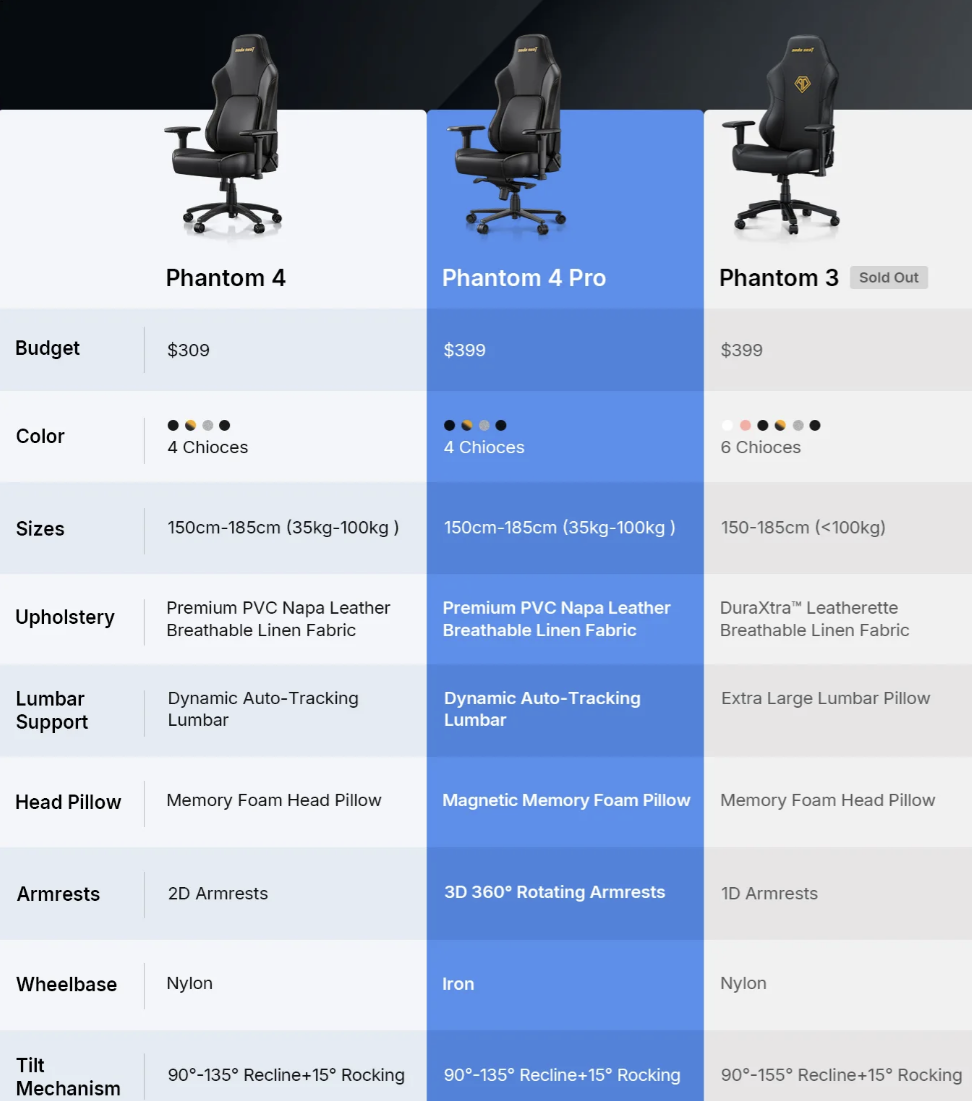
Phantom 4 VS Phantom 4 PRO AndaSeat

2026 Memorial Day Sale AndaSeat Phantom 4
AndaSeat Frames Phantom 4 Series Around a Changing Consumer Expectation: Support That Adjusts to Different Bodies, Not Just Different Rooms
SPOKANE, WA, UNITED STATES, May 24, 2026 /EINPresswire.com/ -- AndaSeat has launched its Memorial Day Sale, featuring sitewide savings of up to $140 off. Within the campaign, the company is placing specific focus on the Phantom 4 Series, which includes the Phantom 4 and Phantom 4 Pro. In this release, however, the central story is not the seasonal discount itself, but a broader consumer issue that has become more visible in ergonomic seating: many users no longer accept the idea that one fixed lumbar shape or one limited support profile will work equally well for everyone.Public workstation guidance helps explain why this question matters. OSHA’s computer workstation materials state that a backrest should be easily adjustable and able to support the back in a variety of seated postures, while its purchasing guide notes that the backrest should be adjustable forward and backward and warns that chairs with only simple tilt movement may not provide adequate adjustment for many users. OSHA’s evaluation checklist also notes that seat width and depth should accommodate the specific user. Together, these materials point to a broader principle: ergonomic usefulness depends not only on having support, but on whether that support can actually fit the person using the chair.
That issue has become more relevant as buyers compare chairs more critically. Consumers are increasingly familiar with the difference between a chair that includes lumbar support in theory and one that can be meaningfully tuned to their body shape, seating preference, and daily posture changes. HSE guidance on display screen equipment similarly states that back support should provide good lower-back support, seat height should be appropriate, and users should have enough room to change position.
AndaSeat said the Phantom 4 Series was developed in response to that fit problem. In the company’s view, support is no longer only about whether a chair has lumbar support at all. It is about whether the user can refine that support with enough range and movement to make it function in practice.
Why “Fit” Has Become a Bigger Seating Problem
In many chair categories, lumbar support is still treated as a binary feature: either a chair has it or it does not. But for many users, the real question is more specific. A lumbar shape that feels correctly placed for one person may feel too shallow, too pronounced, too low, or too fixed for another. Even among users of similar height, torso shape, sitting style, and support preference can vary enough that a fixed lumbar profile may feel supportive to one person and less useful to another.
This is one reason adjustability matters more than feature labels alone. OSHA’s materials repeatedly emphasize that workstation elements should support the user in a variety of postures rather than assume one position fits all. In practical terms, that principle extends to chair design. If support cannot be fine-tuned, consumers may still feel that the chair is asking them to adapt to it rather than the other way around.
AndaSeat said this tension was a key design consideration for Phantom 4 Series. Rather than building the product around a single preset lumbar feel, the company designed the series around a more customizable support system intended to better match different bodies and seating preferences.
The Consumer Pain Point Behind Phantom 4 Series
One of the more common frustrations in everyday seating is not necessarily the total absence of support, but the mismatch between the chair’s support zone and the body’s actual contact points. Some users feel that the lumbar area sits too far back to be effective. Others find that a fixed support shape becomes intrusive when not needed or does not remain aligned once posture changes.
That kind of mismatch can make even a well-built chair feel less convincing in daily use. Consumers are therefore paying more attention to questions such as: Can the lumbar be moved forward when stronger support is needed? Can it sit back when a lighter feel is preferred? Can it continue to provide contact when the body shifts instead of forcing a reset each time posture changes?
AndaSeat said the Phantom 4 Series was created around those questions. According to the company, the product was designed to make lumbar support more configurable and more responsive, rather than treating it as a fixed contour that all users must accept in the same way.
How AndaSeat Frames Phantom 4 Series
According to AndaSeat, the Phantom 4 Series was developed for active sitting across home, work, and gaming use. The company centers the product line on its dynamic auto-tracking lumbar system, which it describes as a motion-responsive support mechanism designed to react to body movement while also offering a more tailored fit through manual adjustment.
A central part of that system is the series’ 15-level depth adjustment, which AndaSeat states provides a 0–95 mm range. In practical terms, this is intended to let users bring the lumbar support further forward when more pronounced contact is needed or release it back when a lighter support profile feels more appropriate. The company also states that, in extended positions, the lumbar can swivel left or right by 5 degrees and tilt forward or backward by 25 degrees, allowing the system to track movement while maintaining back contact.
This is where the Phantom 4 story differs from a simpler lumbar narrative. The company is not presenting support merely as an included feature. It is presenting it as something that should be more adjustable in depth and more responsive in motion so that users can better dial in how the chair fits them.
Why the Depth Range Matters
The depth-adjustment story gives Phantom 4 Series a distinct angle in a market where support is often discussed in broader terms. A fixed lumbar system may be acceptable for some users, but the wider market now includes people who expect more personal control over how a chair feels. OSHA’s own purchasing guidance supports the general idea that more meaningful adjustment is important because many users require different support relationships to achieve a workable posture.
AndaSeat said this was one of the reasons the Phantom 4 Series was designed with 15 locking positions across the lumbar depth range. In the company’s framing, the point is not only that the chair includes lumbar support, but that the support can be adjusted with greater precision instead of forcing users into a narrower fit window.
That framing also helps explain the difference between the two models. The Phantom 4 Pro adds 3D 360-degree rotating armrests, 6.5 cm height adjustment, and a magnetic memory foam head pillow, while the Phantom 4 includes 2D armrests, 10 cm height adjustment, and an elastic-strap head pillow. According to AndaSeat, both models share the same broader support philosophy but provide different routes into the series depending on user preference and feature priority.
Support Customization Beyond the Lumbar
AndaSeat also positions the Phantom 4 Series around a wider support package. The company states that the series uses 55 kg/m³ cold-cure foam in the seat, a 135-degree recline, 15-degree rocking, and magnetic side covers intended to simplify assembly and maintenance. In the context of this release, however, those elements support the main story rather than replace it: the product is being presented as a chair built around more personalized fit.
That distinction matters because consumers are becoming more precise in how they judge ergonomic products. A chair can be well finished, stable, and visually appealing, but if the fit is too generic, users may still regard it as insufficiently tailored for everyday use. By placing the Phantom 4 Series inside a Memorial Day campaign while emphasizing customization rather than only pricing, AndaSeat is framing the chair around a more specific consumer expectation.
Why the Memorial Day Timing Fits
Memorial Day promotions often focus on large daily-use products because the period tends to align with household reassessment and replacement decisions. For workstation seating, that timing is especially relevant when consumers are already comparing products for long-term use rather than for short-term novelty.
In that setting, the Phantom 4 Series is being presented not simply as another chair inside a sales event, but as a product aligned with a more concrete purchasing question: if support needs vary from person to person, should a chair offer more ways to tune that fit from the start.
About the Memorial Day Sale
AndaSeat’s Memorial Day Sale includes sitewide savings of up to $140 off. This release focuses specifically on the Phantom 4 Series, including Phantom 4 and Phantom 4 Pro, and its emphasis on more personalized support configuration through adjustable lumbar design.
About AndaSeat
Founded in 2007, AndaSeat develops ergonomic furniture products for gaming, work, and home environments. Its product portfolio includes ergonomic chairs, desks, and related workspace products designed for hybrid users, home setups, and gaming spaces.
Caroline Chen
AndaSeat
+ + 86 139 2232 2347
email us here
Visit us on social media:
LinkedIn
Instagram
Facebook
YouTube
TikTok
X
Legal Disclaimer:
EIN Presswire provides this news content "as is" without warranty of any kind. We do not accept any responsibility or liability for the accuracy, content, images, videos, licenses, completeness, legality, or reliability of the information contained in this article. If you have any complaints or copyright issues related to this article, kindly contact the author above.
