

Generator for Hurricane Season: Power Outage Checklist for Fridge, WiFi and Phones
Many households begin considering backup power only after a storm has been named. By that time, stores may experience increased demand, fuel availability can become limited, and preparation time becomes shorter.
A practical hurricane power outage checklist covers essential steps before, during, and after a storm, including what devices should be charged in advance, which appliances should receive priority when electricity is unavailable, and how to maintain essential services such as refrigeration, internet access, and mobile communication safely.
What Should Be Done Before a Hurricane Hits?
The most effective preparation takes place before a hurricane makes landfall. Completing essential tasks in advance can help ensure backup equipment and household devices are ready when needed.
Charge All Essential Devices
The first step is ensuring that the backup power station reaches full capacity before severe weather arrives.
The GEYOTO N1000 portable power station can charge from 0 to 80% in approximately 43 minutes and reach a full charge in about 68 minutes. Even when preparation begins after a storm watch is issued, the charging speed provides additional flexibility before potential power interruptions occur.
Once the power station reaches 100% capacity, other essential devices can also be prepared, including:
● Phones, tablets, and smartwatches
● Laptops and portable battery banks
● Medical devices such as CPAP machines, nebulizers, and oxygen concentrators
● USB-rechargeable lanterns and flashlights
Vehicle preparation is also an important part of hurricane readiness. Filling the fuel tank before a storm arrives can help avoid potential disruptions caused by power outages at gas stations and increased demand.
Pre-Cool Food Storage Areas
Setting refrigerators and freezers to their coldest settings 24 to 48 hours before a hurricane arrives can help extend the time food remains at safe temperatures during an outage.
Adding frozen water bottles to the freezer before the storm can provide additional cooling support. The frozen bottles function similarly to ice packs and can help maintain lower temperatures after power loss.
A closed refrigerator generally maintains its temperature for approximately four hours, while a full freezer can remain cold for around 48 hours when kept sealed. Pre-cooling provides additional time for households to manage food storage during extended outages.
Before a storm, downloading offline maps, saving important contact information, and storing insurance documents locally can also help maintain access to essential information if internet services become unavailable.
A key safety consideration involves the use of gas generators. Gas-powered generators should never be operated indoors, inside garages, or near windows or vents. Carbon monoxide produced by fuel-burning equipment can accumulate quickly in enclosed areas and create serious safety risks.
What Should Be Powered First During an Outage?
During a power outage, connecting every available device at the same time may quickly consume stored energy. Prioritizing essential equipment during the first hours of an outage can help extend backup power availability.
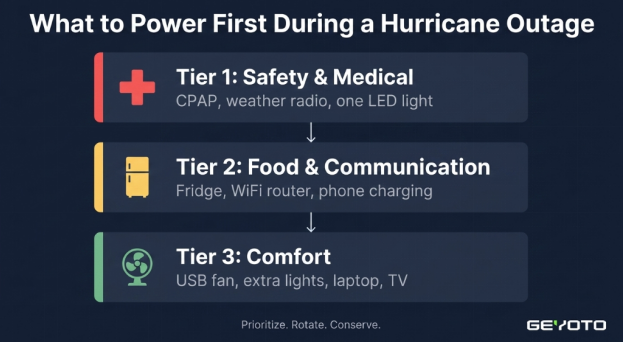
A three-tier approach can help determine which devices should receive power first.
Tier 1: Safety and Medical Needs
The highest priority should be given to equipment directly related to health and safety, including:
● Medical devices such as CPAP machines, oxygen concentrators, and nebulizers
● Weather radios or phones receiving NOAA emergency alerts
● A reliable LED light for the main living area
Tier 2: Food Preservation and Communication
The second priority includes devices that support food safety and communication needs:
● Refrigerators, as reconnecting them earlier can help reduce temperature loss
● WiFi routers and modems for weather updates and emergency communication
● Phone charging for household members
Tier 3: Comfort and Additional Convenience
Additional devices can be connected when remaining battery capacity allows, including:
● Small USB fans instead of larger fans with higher power consumption
● Additional lighting for other areas of the home
● Laptops or tablets, particularly for households with children
● Televisions when sufficient battery capacity remains available
Using power strategically and rotating devices when possible can help extend the operating time of a backup power station. Prioritizing essential equipment allows available energy to support the most important household needs throughout an outage.
How Long Will a Refrigerator Run on Backup Power?
Refrigerator runtime depends on several factors, including the refrigerator model, power consumption, operating conditions, and the capacity of the backup power source.
A refrigerator does not consume a constant amount of electricity. The compressor cycles on and off depending on factors such as room temperature, door openings, and overall efficiency. Understanding the refrigerator’s wattage before an outage can help estimate expected runtime.
Many modern Energy Star refrigerators may consume approximately 100 to 150 watts when the compressor starts, while older or larger units may require 200 to 400 watts or more.
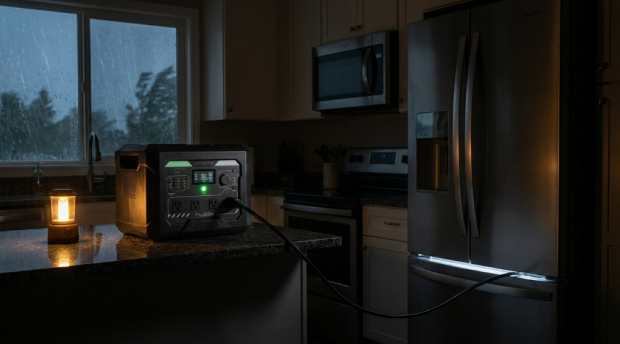
For mini refrigerators or compact units, the GEYOTO N1000, featuring a 1024Wh capacity, can support approximately 6 to 10 hours of operation under typical conditions. Full-size refrigerators generally consume more power, resulting in shorter operating times. The exact runtime depends on the specific appliance specifications and usage conditions.
Several practices can help extend refrigerator runtime during an outage:
Keep the refrigerator door closed as much as possible to reduce cold air loss.
Disconnect non-essential devices from the power station to reserve more capacity for refrigeration.
If an outage continues for an extended period, move important perishable items into a cooler with prepared frozen water bottles.
Checking the refrigerator wattage label, usually located inside the door or listed in the product manual, can provide a clearer understanding of expected power requirements.
How to Keep WiFi and Phones Running
Maintaining communication during hurricane-related outages is an important safety consideration. Internet access and mobile devices can provide weather updates, emergency notifications, and contact options when normal services are disrupted.
A typical home WiFi router consumes approximately 10 to 20 watts, while a modem generally uses around 10 to 15 watts. Combined, the total power requirement is usually around 20 to 35 watts, allowing many portable power stations to support these devices for extended periods.
Connecting the router to a backup power station before the storm arrives can help maintain internet access during an outage. Continued WiFi availability can support access to weather radar, emergency announcements from local authorities, communication with family members, and online services needed after conditions improve.
The GEYOTO N1000 includes a built-in UPS function that switches to battery power in under 10 milliseconds when grid power is interrupted. When operating in pass-through mode with the router connected in advance, the system is designed to maintain continuous power during short interruptions.
A typical smartphone battery contains approximately 15 to 25Wh of capacity. A 1024Wh portable power station can provide multiple smartphone charges during an extended outage. The GEYOTO N300, with a 256Wh capacity, can also recharge smartphones multiple times depending on device specifications and charging conditions.
Both the GEYOTO N1000 and N300 include a foldable Qi2.2 25W wireless charging pad, allowing compatible devices to charge without a traditional cable connection.
To improve smartphone battery efficiency during outages, power-saving measures such as enabling Low Power Mode, reducing screen brightness, disabling unnecessary Bluetooth connections, limiting background app activity, and using WiFi calling when available can help extend battery life.
Is a Portable Power Station a Better Generator for Hurricane Season?
The appropriate backup power solution depends on the specific equipment that needs to remain operational during an outage. Portable power stations and traditional gas generators each offer different advantages depending on household requirements.
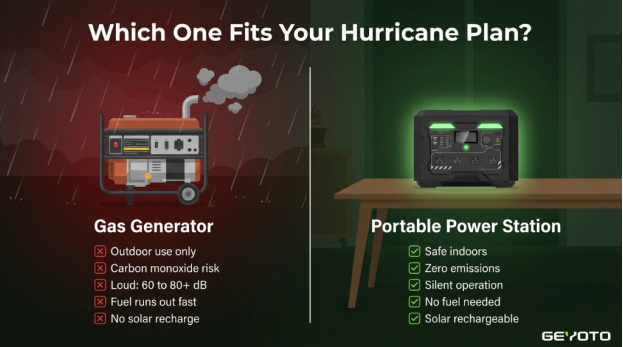
Generator for Hurricane Season: Portable Power Station vs. Gas Generator
Gas generators provide high and sustained power output, making them suitable for operating larger electrical loads such as central air conditioning systems, well pumps, and multiple major appliances simultaneously. For situations requiring whole-home power coverage and heavy electrical demand, gas generators can provide significant output capacity.
However, gas generators also involve several considerations. Fuel-powered generators produce carbon monoxide emissions and must always be operated outdoors, away from garages, windows, and enclosed spaces. Following hurricanes, fuel availability may become limited as gas stations can experience power disruptions and increased demand.
Gas generators can also produce significant operating noise, commonly reaching 60 to 80 decibels or higher depending on the model and operating conditions. These factors can affect convenience and usability during extended power outages.
Why Fuel-Free Backup Power Is Considered
Portable power stations operate differently from traditional fuel generators. Products such as the GEYOTO N1000 use LiFePO4 (Lithium Iron Phosphate) battery technology, producing no direct emissions during operation and operating quietly without requiring gasoline storage.
Because they do not require fuel or outdoor operation, portable power stations can provide an alternative backup power option for locations where traditional generators may be difficult to use, including apartments, condominiums, rental properties, and homes where outdoor generator placement is limited.
Portable power stations can support essential household equipment such as refrigerators, WiFi routers, phones, lights, and medical devices during hurricane-related outages.
Feature Comparison: Portable Power Station vs. Gas Generator
Indoor Safe:
Portable Power Station — Yes
Gas Generator — No
Carbon Monoxide Risk:
Portable Power Station — None
Gas Generator — High
Noise Level:
Portable Power Station — Silent
Gas Generator — 60 to 80+ dB
Fuel Required:
Portable Power Station — No
Gas Generator — Yes, hard to find post-storm
Recharge via Solar:
Portable Power Station — Yes
Gas Generator — No
Best For:
Portable Power Station — Fridge, WiFi, phones, lights, CPAP
Gas Generator — Central AC, well pumps, whole-home
Which GEYOTO Backup Power Setup Fits Different Power Needs?
Different household situations require different levels of backup power capacity. The appropriate configuration depends on which devices need to remain operational during an outage.
For households requiring power for refrigerators, WiFi routers, phones, lights, and CPAP machines, the GEYOTO N1000 provides a 1024Wh capacity and 1800W continuous output. The unit also supports a 2400W constant mode and 3000W P-Boost surge capacity for devices requiring higher startup power.
The GEYOTO N1000 can reach a full charge in approximately 68 minutes through a wall outlet. When paired with the GEYOTO S200 solar panel, the system can also recharge through solar energy after weather conditions improve, providing an additional charging option during longer outages.
For situations where the primary needs involve charging phones, maintaining router operation, powering laptops, and supporting lighting, the GEYOTO N300 offers a more compact option with a 256Wh capacity and 300W output. The unit can reach a full charge in approximately 1.5 hours and is designed for lighter backup power requirements.
The N300 is not intended to operate full-size refrigerators, but it can support communication devices, lighting, and smaller electronics during shorter outages.
Both models use LiFePO4 batteries and include UL indoor safety certification, a three-year warranty that can be extended to five years through member registration, a built-in UPS function with under 10ms switchover, and a 25W wireless charging pad.
Conclusion
Hurricane season requires early preparation, and having a reliable backup power plan before severe weather arrives can help reduce the challenges caused by extended outages.
Households that prepare backup power solutions before storm warnings are issued are generally better positioned to manage long periods without electricity.
Understanding essential power requirements, checking device wattages, and identifying which equipment requires continuous operation can help create a more effective outage plan. Fully charging backup power stations before peak hurricane activity, pre-cooling food storage areas, preparing frozen water bottles, and keeping solar charging options available can provide additional support when grid power is unavailable.
The most suitable generator or backup power solution for hurricane season is not necessarily the largest or most powerful option. Instead, the appropriate choice depends on whether it can safely support essential household needs, maintain communication, preserve food supplies, and provide reliable power without unnecessary risks associated with fuel storage, emissions, or excessive noise.
GEYOTO portable power stations and solar generator kits provide an alternative backup power option for households preparing for hurricane-related outages. Early preparation before the first named storm develops can help ensure backup equipment is ready when needed.
GEYOTO
GEYOTO
email us here
Legal Disclaimer:
EIN Presswire provides this news content "as is" without warranty of any kind. We do not accept any responsibility or liability for the accuracy, content, images, videos, licenses, completeness, legality, or reliability of the information contained in this article. If you have any complaints or copyright issues related to this article, kindly contact the author above.
