

Overlooked repeat DNA may explain missing heritability of schizophrenia and bipolar disorder
News originally published by
EIN Presswire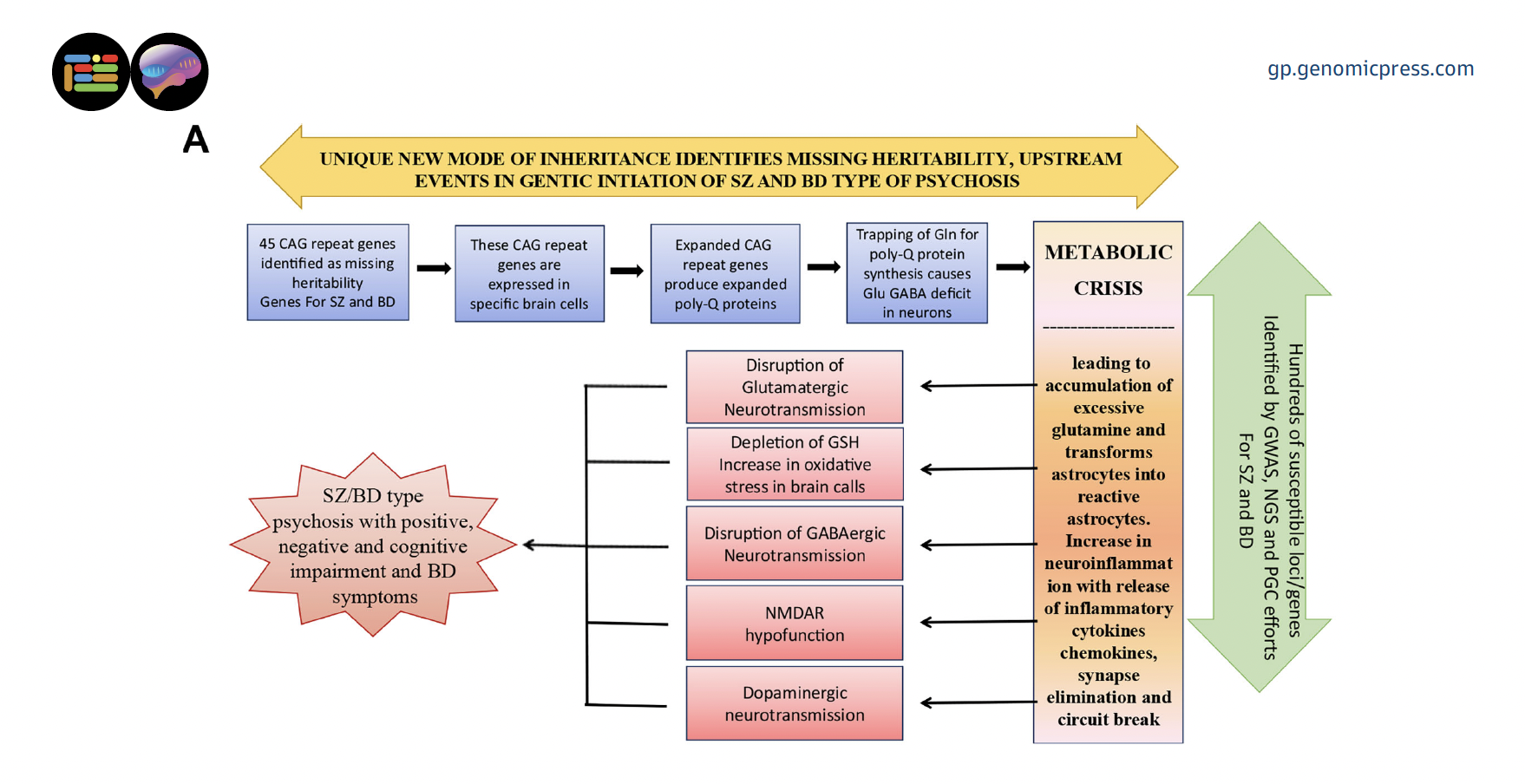
Polymorphic CAG repeat genes initiate upstream events by forming several poly-Q proteins.

Poly-Q-inducedmetabolic dysregulation.
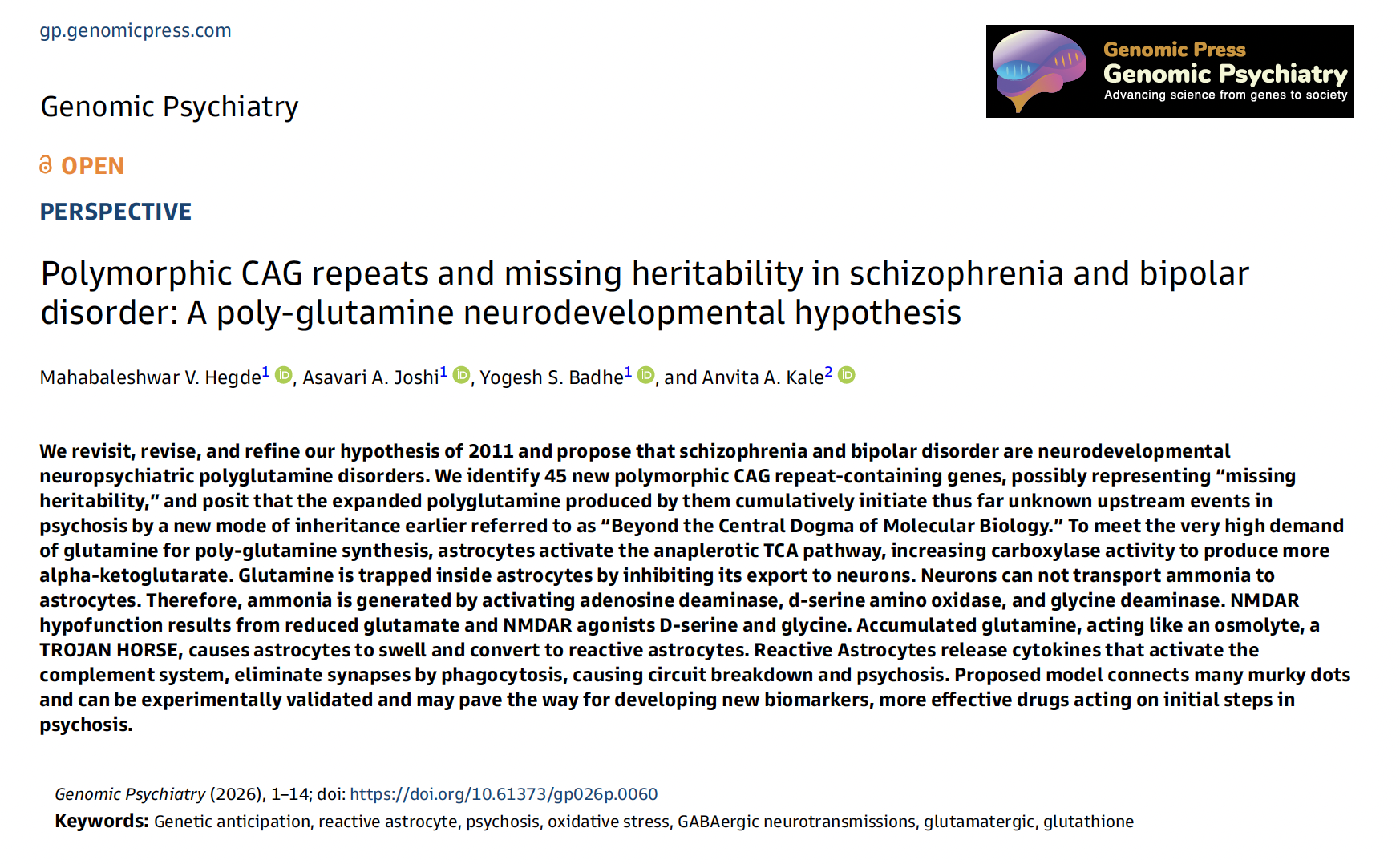
Polymorphic CAG repeats and missing heritability in schizophrenia and bipolar disorder: A poly-glutamine neurodevelopmental hypothesis
Researchers suggest that 45 genes carrying CAG repeats may trap glutamine in brain support cells, starving neurons and setting the stage for psychosis.
The stutter in question is CAG, a three-letter genetic code for the amino acid glutamine, repeated again and again. Expanded far enough in a single gene, such repeats cause Huntington disease and several spinocerebellar ataxias (inherited disorders of movement and coordination), illnesses in which schizophrenia-type and bipolar-type psychosis is reported far more often than in the general population. Mahabaleshwar V. Hegde, Director of the Centre for Innovation in Nutrition Health and Disease at Interactive Research School for Health Affairs, Bharati Vidyapeeth Deemed University, and corresponding author, with Asavari A. Joshi, Yogesh S. Badhe, and Anvita A. Kale, asks a simple question. "What if many modest repeat containing genes, scattered across the brain, could add up to cause highly debilitating chronic mental health condition".
The heritability that went missing is a problem the authors have pursued for more than a decade. They first floated the idea in 2011 under the banner "Unstable Genes Unstable Mind; Beyond the central Dogma of Molecular Biology". Now, drawing on a published catalogue of human CAG-repeat genes, they assemble 45 candidates: ten whose repeats can expand into classic neurodegenerative diseases, three with repeats outside the coding regions that also cause such diseases, and 32 with moderately expanding repeats. One recent estimate attributes about 4 percent of schizophrenia risk to tandem repeats (short DNA sequences repeated back to back) in exons, the protein-coding segments of genes. What the field has lacked, the authors argue, is a mechanism by which these repeats can cause psychosis. Unlike one CAG repeat length beyond 30-35 causing neuronal death and causing neurodegenerative disease, it is suggested that many of the moderately expanded polymorphic CAG repeat genes cause no neuronal death and cumulatively cause schizophrenia and bipolar disorder (SZ/BD) type psychosis. CAG coding for glutamine SZ/BD can also be called as poly-glutamine disorder albeit with a difference.
Mahabaleshwar Hegde and colleagues suggest that newly identified polymorphic CAG repeat genes initiate upstream events in psychosis and GWAS identified risk genes (genes flagged by genome-wide association studies, the large-scale genetic scans of recent decades) carry out the rest of the complementary steps that results in positive, negative and cognitive impairment symptoms of schizophrenia and mood swing depression of bipolar disorder. Therefore, Mahabaleshwar Hegde and colleagues propose that polymorphic CAG repeat variation deserves closer investigation as potentially overlooked dimension in GWA-studies. The proposal that CAG repeat gene expression results glutamine dysregulation in astrocytes is the phenotype caused by new mode of inheritance described as "Beyond the Central Dogma of Molecular Biology."
The proposed mechanism places a Trojan horse inside the astrocyte. The chain runs through astrocytes, the support cells that supply neurons with glutamine, the raw material for glutamate and GABA, the main carriers of excitatory and inhibitory signals. If many genes produce proteins with enlarged glutamine stretches, the authors reason, astrocytes face an outsized demand of glutamine. Where would the extra glutamine come from? Astrocytes, in this model, switch on a metabolic side route to make more alpha-ketoglutarate, scavenge ammonia from sources that include D-serine and glycine (two molecules that NMDA receptors, a major class of glutamate receptors, need to work), and adenosine and hold glutamine back instead of exporting it to neurons.
Neurons would then run short of glutamate, GABA, and the antioxidant glutathione. Glutamine piling up inside astrocytes could behave like a Trojan horse, a term borrowed from hepatic encephalopathy (a brain disorder caused by liver failure), where trapped glutamine swells astrocytes and turns them reactive. Reactive astrocytes can release inflammatory signals, recruit complement (part of the immune system's defenses), and eliminate synapses. Circuits break, and in this model, psychosis follows. Why would one root produce two different illnesses, schizophrenia and bipolar disorder, and their subtypes? The authors propose that the answer lies in geography: which brain regions the expanded genes act in, and which receptors those regions carry, with NMDA receptor hypofunction (reduced activity) favouring schizophrenia-type symptoms and metabotropic glutamate receptor 5 implicated in bipolar disorder.
What the most powerful 7-tesla brain scanners see bears directly on the model. Why should anyone take a metabolic story seriously? Because brain imaging has recently become sharp enough to test part of it. At 3 tesla and below (the tesla is the unit of a scanner's magnetic field strength), glutamate and glutamine signals overlap and were long reported together, often read as a sign of excess glutamate. At 7 tesla, magnetic resonance spectroscopy, a scanning technique that measures chemical levels in living tissue, can separate them. A meta-analysis of 28 studies, with 647 patients and 608 controls, concluded that glutamine rises and glutamate falls in the medial frontal region in schizophrenia.
"These measurements are the most encouraging fit for our model, but they carry a real limitation," said Mahabaleshwar V. Hegde. "Spectroscopy reports totals for a whole region. Assigning the higher glutamine to astrocytes and the lower glutamate, GABA, and glutathione to neurons is a model-based inference consistent with the data, not something the scans prove directly."
Several murky dots might connect under this framework. Part of the appeal, the authors argue, is that it links observations that have long floated free. Genetic anticipation, in which illness arrives earlier or more severely in later generations, is a hallmark of repeat diseases and has been reported in both disorders, though earlier researchers attributed it to ascertainment bias, a distortion arising from how patients were selected for study. In Huntington disease and spinocerebellar ataxia 17, longer CAG repeats track with earlier onset not only of the neurological illness but of psychosis. Men develop schizophrenia three to four years earlier than women, and the authors speculate that the highly unstable repeat in the androgen receptor gene (the receptor for male sex hormones), on the X chromosome, could explain. Could expanded CAG repeat stretches on androgen receptor gene on sex chromosome account for the early onset of psychosis in men than in women?
"Schizophrenia and bipolar disorder are neurodevelopmental disorders, and in this model the metabolic burden accumulates until it crosses a threshold," said Hegde. "Because the mechanism we propose involves glutamate deficits rather than excitotoxicity, it does not predict neuronal death, which fits a neurodevelopmental rather than a neurodegenerative course."
The authors are explicit that this is a hypothesis built to be tested, and that the inference drawn with the assumption that unstable CAG repeat genes are root cause of SZ/BD type psychosis needs to be proved. The repeat-length data needed to estimate how much heritability these genes explain do not yet exist for schizophrenia and bipolar populations. Even the best-studied candidate, a repeat in the KCNN3 potassium channel gene, has replicated in some cohorts and not in many others, which the authors read as a sign that it cannot act alone. Direct evidence linking glutamine accumulation in astrocytes to neuroinflammation in schizophrenia, is borrowed from the astrocyte data of hepatic encephalopathy, but the data from SZ and BD need to be checked.
Having said this, Mahabaleshwar Hegde and his colleagues do believe that when the whole field is looking for new ideas to come out of the present imbroglio, the suggestion that multiple polymorphic CAG repeat genes are missing genes and the fact that we are able to derive a mechanism how the expression of these genes can lead to entire spectrum psychotic symptoms, request for urgent attention by all the scientific community interested in solving the SZ/BD genetic puzzle. Suggestion that several genes activation already reported like pyruvate carboxylase, glycine, D-serine, adenosine deaminases, BDNF, GFAP, AQP4, proinflammatory cytokines like TNF-alpha, complement system and synapse loss and circuit break, cause psychosis, which is suggested to be the consequence of expanded CAG repeat gene expression, by the authors. Explaining the already reported dysregulation of many genes in schizophrenia strongly support the hypothesis and needs further substantiation by research.
So what would settle that many polymorphic CAG repeats in SZ and BD are abnormally expanded? Computational tools for profiling tandem repeats across the genome now exist, and single-cell transcriptomics, which reads gene activity in individual cells, could map where each gene is expressed. If the model holds, the authors suggest, repeat profiles could yield biomarkers for illnesses still diagnosed by subjective assessment, and drugs aimed at the earliest metabolic steps might treat both disorders. For a problem the authors call notoriously intractable, a map that can be proven wrong is worth having.
The peer-reviewed Perspective in Genomic Psychiatry titled "Polymorphic CAG Repeats, Astrocyte Glutamine dysregulation and Missing Heritability in Schizophrenia and Bipolar Disorder: A polyglutamine Neurodevelopmental Hypothesis," is freely available via Open Access, starting on 10 November 2026 in Genomic Psychiatry at the following hyperlink: https://doi.org/10.61373/gp026p.0060
The full reference for citation purposes is: Hegde MV, Joshi AA, Badhe YS, Kale AA. Polymorphic CAG Repeats, Astrocyte Glutamine dysregulation and Missing Heritability in Schizophrenia and Bipolar Disorder: A polyglutamine Neurodevelopmental Hypothesis. Genomic Psychiatry 2026. DOI: https://doi.org/10.61373/gp026p.0060. Epub 2026 Nov 10.
About Genomic Psychiatry: Genomic Psychiatry: Advancing Science from Genes to Society (ISSN: 2997-2388, online and 2997-254X, print) represents a paradigm shift in genetics journals by interweaving advances in genomics and genetics with progress in all other areas of contemporary psychiatry. Genomic Psychiatry publishes peer-reviewed medical research articles of the highest quality from any area within the continuum that goes from genes and molecules to neuroscience, clinical psychiatry, and public health.
Visit the Genomic Press Virtual Library: https://issues.genomicpress.com/bookcase/gtvov/
Our media website is at: https://media.genomicpress.com/
Our full website is at: https://genomicpress.com/
Ma-Li Wong
Genomic Press
mali.wong@genomicpress.com
Visit us on social media:
X
LinkedIn
Bluesky
Instagram
Facebook
YouTube
Legal Disclaimer:
EIN Presswire provides this news content "as is" without warranty of any kind. We do not accept any responsibility or liability for the accuracy, content, images, videos, licenses, completeness, legality, or reliability of the information contained in this article. If you have any complaints or copyright issues related to this article, kindly contact the author above.
